CPSH Seminar Series: Christopher German, Woods Hole Oceanographic Institute
January 16, 2026
April 27, 2026 at 1:00pm CT
Location: Classroom 15.216B, Physics, Math and Astronomy Bldg.
UT Austin, Department of Astronomy
2515 Speedway, Stop C1400
Austin, Texas 78712-1205
Online: To join online contact Brandon Jones.
Get seminar links sent straight to your inbox, subscribe to our seminar mailing list.
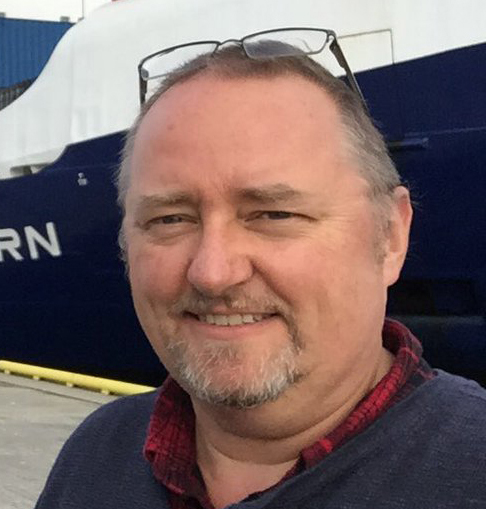
Speaker: Christopher German, Woods Hole Oceanographic Institute
Host: Elizabeth Spiers
Title: Putting the “Ocean” into the exploration of Ocean Worlds for Life
Abstract: Ocean Worlds of the outer solar system – not least Europa and Enceladus – present compelling targets, within our own solar system, in the search for life beyond Earth. Key to upcoming missions and mission concepts is the notion that water-rock interactions at the bottom of oceanic water-columns can lead to the establishment of chemical (redox) disequilibria that can sustain microbial metabolisms on Earth and, hence, may render other ocean worlds habitable and – perhaps – inhabited. In this presentation I will touch on some of the key developments in seafloor hydrothermal research on Earth that have allowed such hypotheses to mature, and advances in marine robotics that can help prepare for future ocean worlds exploration. I will highlight some specific new insights into ocean worlds research developed from folding in expertise from Earth system science during a recently completed NASA ICAR project (2020-2025) and introduce a new project (2026-2030) that seeks to build on that and address the challenges that we anticipate when searching for biosignatures among an abiotic background.
Biography: Chris German is a marine geoscientist who specializes in the exploration for and study of submarine vents. He earned a BA in Natural Sciences at the University of Cambridge (Advanced Chemistry / Geological Sciences) and stayed for a PhD in Marine Geochemistry. Following a 2 year Postdoctoral Fellowship at MIT (which provided him with his first dives in the submersible, Alvin), he returned to the UK as a full time researcher at the UK’s national oceanography center science. He returned to the US to take up his current position as a Senior Scientist at WHOI in 2005, but for the first decade he doubled up as the Chief Scientist for the National Deep Submergence Facility. In 2015, Chris received an Alexander von Humboldt Foundation research prize and it was during that year abroad, in Germany, that he first began to pay serious attention to Ocean Worlds. In 2020 he was selected to found and co-lead the NASA Astrobiology Program’s Network for Ocean Worlds.